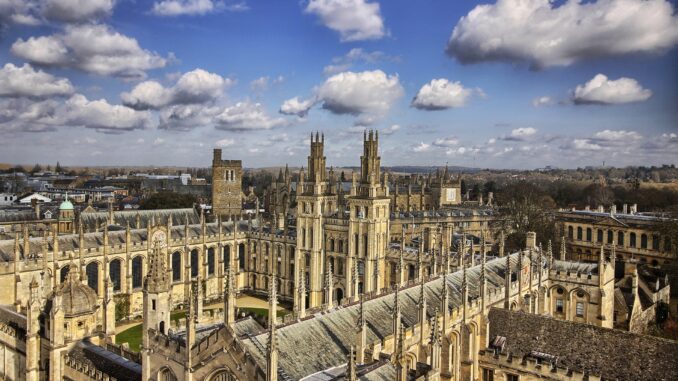
- Cambridge Oxford region’s economy could grow to £235bn (GVA) by 2030, helping support the UK’s R&D agenda by acting as its innovation engine
- However, the Arc will miss out on £50bn of growth (GVA) – 2pc of GDP – without central coordination of its high-value life science and tech sectors
- Over 60 major investors, universities and trade bodies including the CBI and Sir John Bell, want a central government-led body to coordinate development, skills and investment policy to grow the region into a ‘supercluster’ similar to Silicon Valley
A new report, featuring 60 major investors, universities and trade bodies, warns that the UK is set to lose out on £50bn by 2030 – 2 per cent of GDP – if the Oxford-Cambridge Arc ambition is shelved by the government.
The report calls for government coordination to ensure that the Arc can be transformed into an area which can rival world-leading innovation clusters like Silicon Valley. $3.1 billion was raised by Oxbridge firms from venture capital firms between January to June 2021
Across the Oxford- Cambridge Arc, thousands of companies are pioneering new technologies in ground- breaking sectors like aerospace, automation, genetics and AI; digital infrastructure, forensics, microbiology and medical equipment, supercharging our future with fresh ideas and innovation.
The constrained supply of laboratory and office space jeopardises the international competitiveness of the UK’s knowledge economy. £5bn+ of RD&I investment is currently being sought across the Arc and a demand for one million sq. ft. of laboratory space with only 32,000 sq. ft. available. Companies like Oxford Nanopore, Exscientia, Illumina and other future unicorns are joining a long waiting list for space.
The Oxford-Cambridge Arc is set to grow to £235bn by 2030 and already supports 2 million jobs. As the birthplace of the Oxford-AstraZeneca Covid-19 vaccine, the region’s scientific hubs proved instrumental to the effort to curb the spread of Coronavirus globally – and it is partly thanks to this that UK GDP now sits just 0.5 per cent below pre-pandemic levels.
To ensure we are able to compete on a global scale and tackle the shortage of skilled workers, the report calls for the establishment of a Science and Tech Growth Board, alongside space for knowledge-intensive R&D and to set up a Skills Task Force with further and higher education bodies working alongside business and industry leaders.
The report features a wealth of 60 major investors, including:
Miles Kirby, CEO, DeepTech Labs:
“One of the key things that the Arc can boast is connecting back to academia, particularly the University of Cambridge which DeepTech Labs works extensively with. Companies can connect with individual professors in university departments and recruit from an enviable talent pool in the form of world-class, post-doctoral students already located in Oxford-Cambridge Arc.”
“I think the ecosystem is growing, the flywheel is accelerating, and the momentum building. Deep tech is ever expanding and investment can result in world-changing outcomes. DeepTech Labs focuses on brand-new technology ideas that are highly patentable, and we’re picking out all kinds of fascinating ideas from the wellspring of entrepreneurs within the Arc: from a company building next generation processors, companies doing machine learning for object recognition, and one looking at fruit harvesting using drones and assessing yields in agriculture. These ideas have the potential to completely transform our everyday lives and help us to meet climate and social goals with the right mentorship in place.
Accelerators like DeepTech Labs expect further interest in the Arc as investment continues to snowball: something which develops the national economy, unlocks social prosperity, and helps to solve some of the key issues of our age.”
Other contributors include:
- Michael Anstey, Partner, Cambridge Innovation Capital
- Sebastian Johnson, Head of Innovation and Inward Investment, OxLEP
- Dr Andy Gilchrist, The Energy Systems Accelerator Oxford
- Martin Garratt, Chief Executive, Cambridge Cleantech
To download the full report click here.
Full list of contributors to Radical Capital
- Sir John Bell, Regius Professor of Medicine, University of Oxford
- Nathan Bostock, CEO, Santander UK
- Dr Andy Williams, Vice President — Cambridge Strategy, AstraZeneca
- Andrew Teacher, Founder & Managing Director, Blackstock Consulting
- Patrick MacMahon, Senior Partner, Bidwells
- Dr Barbara Ghinelli, Director, Harwell UKRI-STFC
- David Williams, Director, Harwell Campus
- Dr Phil Clare, Director of Innovation & Engagement, University of Oxford
- Richard Tunnicliffe, Director – East of England, CBI
- Prof Bill David, University of Oxford and Harwell, UKRI-STFC
- Prof Yvonne Barnett, Deputy Vice-Chancellor, Anglia Ruskin University
- Leah Thompson, Enterprise Manager, Enterprising Oxford
- Dr Julia Wilson, Associate Director, Wellcome-Sanger Institute
- Dr John Baker, Senior Vice President, Abcam
- Yvette Lamidey, Co-Founder Central Arc Angels
- Edward Lee, Partner & Head of Corporate & Commercial, BlaserMills Law
- Miles Kirby, CEO, DeepTech Labs
- Mike Anstey, Partner, Cambridge Innovation Capital
- Pete Wilder, Head of Property, Oxford Science Enterprises
- Jason Mellad, Founder & Managing Director, Start Codon
- David Mott, Founder Partner, Oxford Capital
- Pete Gladwell, Group Social Impact & Investment Director, Legal & General
- Pete Bachmann, Managing Director – Sustainable Infrastructure, Gresham House
- Alistair Lomax, Director, AUG
- Bev Hindle, Executive Director, Arc Leadership Group
- Richard Hepworth, Group Director of Project Management, Urban & Civic
- Andrew Taylor, Group Planning Director, Countryside
- Prof Lynette Ryals OBE, CEO, MK:U
- Prof Karen Holford CBE, Vice-Chancellor, Cranfield University
- Hilary Chipping, Chief Executive, SEMLEP
- Viren Patel, Director of Development, Open University
- Sebastian Johnson, Head of Innovation & Inward Investment, OxLEP
- Mark Nicholson, CEO, Vivacity Labs
- Bill Kane, President – East Coast & UK Markets, BioMed Realty
- Anna Strongman, CEO, Oxford University Developments
- Doug Cuff, Vice President of UK Real Estate, IQHQ
- Sam Darby, Head of Development, Bruntwood SciTech
- Dr Kath Mackay, Director of Life Sciences, Bruntwood SciTech
- Artem Korolev, Founder & Managing Director, Mission Street
- Harriet Fear MBE, Director, Cambridge&
- Dan Thorp, Director of Policy & Programmes, Cambridge Ahead
- Dr Jerry Wu, Head of Investment, TusPark UK
- Richard Turnill, Senior Bursar, Trinity College Cambridge
- Prof Greg Clarke CBE, Chair, Connected Places Catapult
- Dr Tim Moonen, Founder & Managing Director, Business of Cities
- Andy Martin Consulting, Founder, Andy Martin Consulting
- Salah Mussa, Chair, Mercantile Group
- Chris Mortensen, Co-Founder & COO, Modulous
- Martin Garrett, Managing Director, Cambridge Cleantech
- Dr Andy Gilchrist, Director, Oxford TESA
- Stuart Cole, Head of Sustainability, Living Oxford
- Rich Stockdale, Managing Director, Oxygen Conservation
- Annette Jezierska, Founder & CEO, The Future Fox
- Prof Mark Tewdwr-Jones, Bartlett School of Planning, UCL
- Alex Robinson, Director of Development, Grosvenor
- Hugo Llewelyn, Managing Director, Newcore Capital Management
- Richard Jackson, CEO, Present Made
- Jo Cowen, CEO, Jo Cowen Architects
- Olaide Oboh, Director, Socius
- Clark Dean, Executive Managing Director, Transwestern
