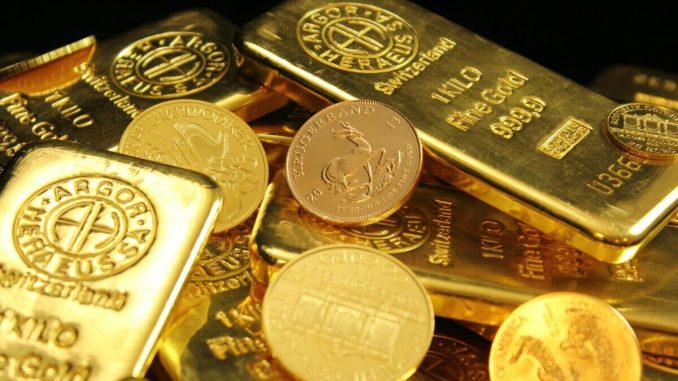
Gold prices slipped lower on Tuesday as stronger Treasury yields and a firmer US dollar continued to weigh on investor sentiment, with analysts warning that persistent inflation concerns and geopolitical uncertainty could keep pressure on precious metals in the near term.
Market attention remains firmly focused on developments in the Middle East after hopes of a potential US-Iran peace agreement faded, helping to keep oil prices elevated and fuelling concerns that inflation could remain stubbornly high.
Higher oil prices are widely seen as adding inflationary pressure to the global economy, increasing the likelihood that central banks may hold interest rates at elevated levels for longer than previously expected.
That environment has supported government bond yields, while simultaneously reducing the appeal of non-yielding assets such as gold.
Zaheer Anwari, Co-Founder and CEO at The Revacy Fund, said markets are increasingly shifting towards the expectation that the US Federal Reserve may leave interest rates unchanged throughout the remainder of the year.
He also pointed to renewed inflationary pressure in Europe, particularly in Germany, as another factor influencing global market expectations.
German inflation was confirmed at 2.9% in April, reinforcing speculation that the European Central Bank could maintain a tighter monetary policy stance for longer.
The stronger policy outlook on both sides of the Atlantic has helped support the dollar and bond yields, creating a more difficult backdrop for gold despite continued geopolitical tensions.
Investors are now looking ahead to upcoming US inflation data, which is expected to play a major role in determining the next direction for both bond yields and precious metals markets.
Analysts say any signs of persistent inflation could further strengthen expectations that central banks will delay rate cuts, potentially adding more pressure to bullion prices.
At the same time, ongoing instability in the Middle East continues to create uncertainty across energy markets, particularly through its impact on oil supply and inflation expectations.
Despite the recent weakness in gold prices, longer-term sentiment towards bullion remains supported by continued central-bank buying activity around the world.
Anwari said The Revacy Fund currently remains neutral on both gold and oil markets, with both assets continuing to trade within established ranges.
He noted that gold has continued to find support around last year’s highs, but suggested that a breakout above current record levels could trigger the start of a new long-term bull market.
According to the fund, such a move could eventually pave the way for gold to target the $10,000 level over the longer term.
In oil markets, analysts are also closely watching technical resistance levels, with a break above March highs potentially opening the door to a move towards $140 per barrel.
For now, however, The Revacy Fund said its primary risk allocation remains focused on the continuing strength of global equity markets.
Source: Press Release