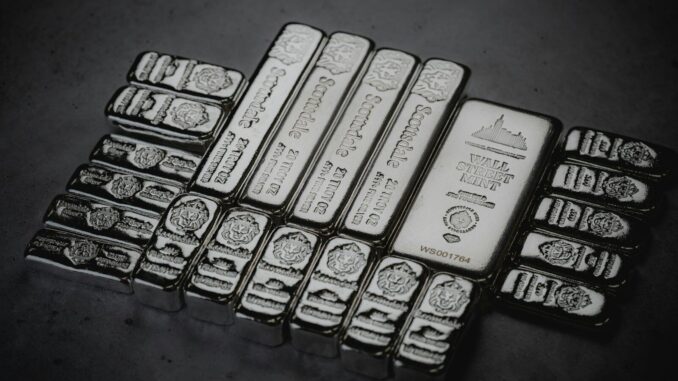
Silver prices remained under pressure on Tuesday, trading close to their lowest level in a year as investors awaited crucial US economic data, Federal Reserve policy signals and Nvidia’s earnings announcement for clues about the precious metal’s next move.
After a sustained period of losses, silver showed signs of stabilising as the US dollar held relatively steady, providing temporary relief to the market. However, analysts warn that the pause may prove short-lived, with concerns about higher interest rates and weakening industrial demand continuing to weigh on the outlook.
According to market analysis from Bas Kooijman, CEO and Asset Manager of DHF Capital S.A., the combination of monetary policy uncertainty and questions over the strength of artificial intelligence investment could determine whether silver stabilises or falls to fresh lows.
Unlike gold, which is primarily influenced by investment demand, central bank activity and its role as a store of value, silver has substantial industrial applications. This makes the metal particularly sensitive to changes in manufacturing activity, technology investment and expectations for global economic growth.
Federal Reserve Interest Rate Decision Could Determine Silver’s Next Move
One of the most significant factors influencing silver prices is the outlook for US interest rates.
Kooijman’s analysis indicates that markets have fully priced in a 25-basis-point increase in the Federal Reserve’s benchmark interest rate at its December meeting.
This places considerable importance on the release of the Federal Reserve’s latest meeting minutes and forthcoming US economic indicators, which could influence expectations about the pace of monetary tightening.
If policymakers signal that inflation remains a concern, investors could begin pricing in a larger 50-basis-point increase or additional interest rate rises during 2027.
Such a development would be particularly challenging for silver.
Higher US interest rates typically increase the yields available on government bonds and other interest-bearing investments, making non-yielding assets such as precious metals relatively less attractive.
Rising Treasury yields can therefore encourage investors to move capital away from silver, particularly when the economic outlook is uncertain.
A more restrictive Federal Reserve stance could also support the US dollar, creating an additional obstacle for silver prices.
Because silver is generally priced internationally in dollars, a stronger US currency can make the metal more expensive for buyers using other currencies, potentially reducing demand.
Conversely, softer economic data or a less aggressive policy outlook could ease pressure on Treasury yields and provide some support for precious metals.
Weak Chinese Industrial Demand Adds to Market Concerns
While monetary policy remains an important short-term driver, silver is also facing challenges from the industrial sector.
China is a major consumer of industrial metals, with manufacturing activity influencing demand across electronics, renewable energy equipment and other advanced technologies.
Weakness in Chinese industrial production can therefore have consequences for global silver consumption.
Silver is widely used in electrical contacts, electronic components, solar photovoltaic technology and other applications requiring high electrical conductivity.
Its role in industrial production means that slowing manufacturing activity can reduce demand even when investors continue to view precious metals as potential safe-haven assets.
For silver producers and investors, this creates a more complicated market environment than that faced by gold.
Although silver can benefit from periods of financial uncertainty, weaker industrial activity may offset some of that support.
Continued weakness in Chinese manufacturing could consequently limit the potential for a sustained recovery, particularly if demand from other major industrial economies also slows.
Nvidia Earnings Become a Key Test for AI-Related Demand
Another important factor highlighted by Kooijman is the potential influence of Nvidia’s financial results on sentiment towards industrial metals.
The semiconductor manufacturer has become a central company in the global artificial intelligence investment cycle, supplying advanced processors and computing technology used in AI data centres.
Its earnings announcements are closely watched for evidence of continued spending by major technology companies on AI infrastructure.
Although Nvidia does not determine global silver demand directly, its financial performance and forward guidance can provide an indication of investment trends across the wider technology industry.
Silver has applications in electronic components, electrical connections and other technologies used within computing and communications infrastructure.
Continued expansion of AI data centres and associated electrical systems could therefore provide some support for industrial silver consumption.
However, the relationship is indirect, and the scale of additional silver demand attributable specifically to AI investment remains uncertain.
If Nvidia reports strong demand and maintains an optimistic outlook, investors may interpret the results as evidence that technology infrastructure spending remains resilient.
By contrast, weaker-than-expected earnings or guidance suggesting slower AI investment could increase concerns about future industrial demand.
For a silver market already struggling with weak manufacturing activity and the prospect of higher borrowing costs, disappointing technology sector results could add to bearish sentiment.
Bas Kooijman: Silver Remains Vulnerable to Further Declines
Bas Kooijman, CEO and Asset Manager of DHF Capital S.A., provided the following market analysis:
Silver steadied on Tuesday after a run of losses, as a stable US dollar offered a brief reprieve, but the metal stayed close to a one-year low. The pause reflects caution. Investors are waiting for key US economic data and Nvidia’s earnings, and those two catalysts are set to decide silver’s direction in the near term.
Markets fully price in a 25-basis-point Federal Reserve rate increase in December, so it is up to this week’s Fed minutes and the coming data to shift expectations. A hawkish tilt would revive bets on a 50-basis-point move or more tightening next year. That would lift Treasury yields and raise the cost of holding a metal that pays no yield, leaving silver open to fresh lows.
Demand offers little cushion. Weak industrial activity in China continues to weigh on consumption. AI investment remains a source of support. That makes Nvidia’s results and guidance today a direct read on the sector’s spending. Any sign that this investment is slowing would remove one of the few remaining supports for industrial demand and strengthen the bearish case.
What Could Trigger a Recovery in Silver Prices?
Despite the current pressure, several developments could improve the outlook for silver.
A moderation in US inflation or weaker economic data could reduce expectations for further Federal Reserve tightening, potentially easing pressure on bond yields and the dollar.
An improvement in Chinese manufacturing activity could also support industrial consumption, particularly in electronics and renewable energy applications.
Meanwhile, sustained investment in AI infrastructure, electricity networks and advanced technology could provide additional demand for silver-containing components.
Supply conditions will also remain important.
A significant proportion of global silver production comes as a by-product of mining for other metals, including copper, lead and zinc. This means silver supply does not always respond quickly to changes in its own market price.
If industrial demand strengthens while mine supply remains constrained, the resulting imbalance could eventually support prices.
However, any recovery would need to overcome the immediate pressures associated with monetary policy and weaker manufacturing activity.
Outlook: Investors Await Two Major Market Signals
For the immediate future, silver’s direction is likely to depend heavily on the interaction between US monetary policy expectations and confidence in industrial demand.
The Federal Reserve’s meeting minutes and forthcoming economic data will provide investors with further insight into whether policymakers are likely to maintain a restrictive stance.
At the same time, Nvidia’s earnings and guidance could influence expectations for technology sector investment, particularly in AI infrastructure.
A combination of hawkish Federal Reserve signals and disappointing technology sector results would potentially increase downward pressure on silver, leaving the metal vulnerable to further declines.
Alternatively, signs of easing monetary policy concerns and continued resilience in AI-related investment could help stabilise prices.
For now, the market remains caught between the possibility of longer-term industrial demand growth and the immediate challenges of higher interest rates, weak Chinese manufacturing activity and cautious investor sentiment.
With silver already trading near a one-year low, the coming economic and corporate announcements could prove particularly important in determining whether the metal begins to recover or extends its recent losses.
Sources/References
-
DHF Capital: https://dhf-capital.com/
-
US Federal Reserve – Monetary Policy: https://www.federalreserve.gov/monetarypolicy.htm
-
Nvidia Investor Relations: https://investor.nvidia.com/
-
The Silver Institute: https://silverinstitute.org/
Financial disclaimer: This article is provided for general information only and does not constitute financial or investment advice. Commodity prices can be volatile, and investors should conduct their own research and seek independent professional advice before making investment decisions.