
A decade after the introduction of Pension Freedoms, new research from Fidelity International highlights the financial journey of the first retirees to take advantage of these reforms. The analysis shows that those who adopted the widely recommended ‘4% rule’—withdrawing 4% annually from a £100,000 pension pot—would today have nearly doubled their remaining savings to £189,000, even after a decade of withdrawals.
A Decade of Pension Freedoms
Pension Freedoms, introduced in April 2015, allowed UK retirees greater flexibility in managing their pension savings. Rather than being obligated to purchase an annuity, individuals were given the freedom to keep their funds invested while drawing income at their discretion. While this created new opportunities for growth, it also exposed retirees to market fluctuations, particularly in the crucial early years of retirement.
Despite concerns over potential downturns, many retirees have fared well. According to Fidelity’s findings, 2.6 million people had accessed their pension funds flexibly by 2023/24, leveraging market performance to sustain and grow their income sources.
The Class of 2015: Market Growth in Action
To illustrate how these retirees have navigated their financial journeys, Fidelity modelled the experience of a hypothetical retiree who withdrew 4% annually from a £100,000 pension pot, with adjustments for inflation. Using historical market data from 2015 to early 2025, the study examined different withdrawal rates and portfolio strategies.
For those who invested entirely in global equities, the results were striking:
| Withdrawal Rate | Total Withdrawn Over 10 Years | Pot Remaining (2025) | Lowest Pot Value (Date) |
|---|---|---|---|
| 4% | £47,779 | £188,977 | £81,660 (Feb 2016) |
| 5% | £59,749 | £169,809 | £80,771 (Feb 2016) |
| 6% | £71,698 | £150,642 | £76,537 (Mar 2020) |
| 7% | £83,648 | £131,474 | £71,925 (Mar 2020) |
The analysis reveals that even retirees withdrawing 7%—a figure above standard financial advice—still retained over £131,000 in savings after 10 years.
A Smoother Ride with a Diversified Portfolio
While an all-equities approach delivered significant returns, Fidelity also examined a more balanced strategy—investing 60% in equities and 40% in bonds. This reduced volatility but resulted in slightly lower final balances.
| Withdrawal Rate | Total Withdrawn Over 10 Years | Pot Remaining (2025) | Lowest Pot Value (Date) |
| 4% | £47,779 | £157,892 | £89,845 (Aug 2015) |
| 5% | £59,749 | £141,992 | £89,845 (Aug 2015) |
| 6% | £71,698 | £125,952 | £89,845 (Aug 2015) |
| 7% | £83,648 | £109,983 | £88,979 (Feb 2016) |
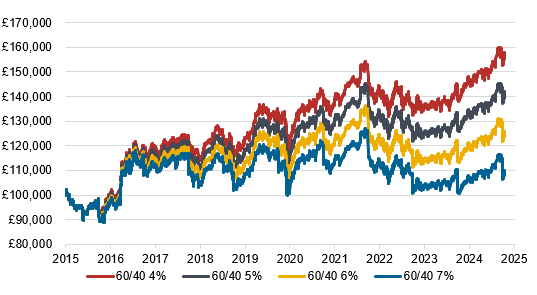
While final balances were lower, the diversified approach cushioned retirees against sharp downturns, reducing the risk of early depletion.
Market Performance: Luck or Strategy?
Ed Monk, Associate Director at Fidelity International, commented: “What stands out is how resilient these pension pots have been. Even those withdrawing at higher-than-recommended rates have seen their funds sustain strong levels. The class of 2015 were fortunate in that markets rebounded from downturns relatively quickly, avoiding the worst-case scenario of having to sell assets at low prices.”
However, Monk warns that future retirees cannot solely rely on strong markets. “While history has been kind to this group, future retirees may not experience the same favourable conditions. It’s crucial to have a strategy in place, such as maintaining a cash buffer of two to three years’ worth of income, to prevent forced asset sales during downturns.”
Comparing Pension Freedoms to Annuities
The study also compared Pension Freedoms with traditional annuities. In 2015, a £100,000 annuity would have provided a fixed annual income of approximately £5,304. In contrast, those who invested in the market under Pension Freedoms often achieved similar or higher income while maintaining a larger pot.
Preparing for the Next Decade
As the next generation of retirees prepares for their financial future, the key takeaway is balance: maintaining investment growth while managing risk. Fidelity recommends considering diversified portfolios, withdrawal flexibility, and keeping a reserve fund for emergencies.
For those approaching retirement, seeking financial guidance is essential. The government’s Pension Wise service offers free, impartial guidance on retirement options, and Fidelity’s specialists are also available to assist retirees in making informed decisions about their financial future. To learn more, visit https://www.fidelity.co.uk/fidelity-retirement-service/
