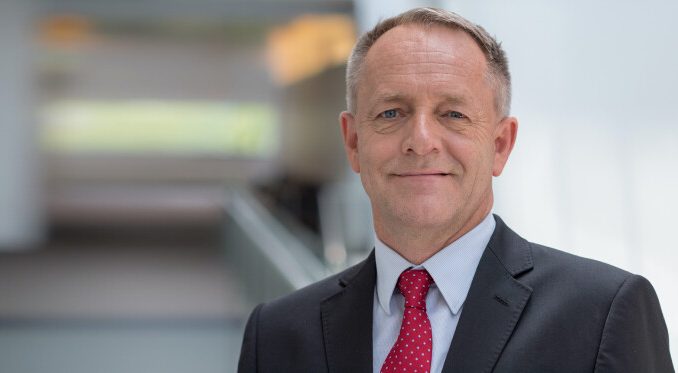
Dr Peter Westaway is one of the UK’s most respected economists, having spent over a decade advising on monetary policy at the Bank of England and leading European research as Chief Economist at Vanguard Asset Management.
With a Cambridge PhD and academic stints at both Oxford and Queen Mary University, Peter blends deep theoretical insight with real-world economic expertise.
A sought-after economics speaker and media commentator, he is known for his ability to make complex financial systems accessible to all.
In this exclusive interview with The Champions Speakers Agency, Peter discusses the global inflation outlook, shifting interest rates, and why businesses must urgently confront ESG responsibilities—while also sharing sharp insights on the transformative power of artificial intelligence in today’s labour market.
Q: As someone with extensive experience advising central banks, how do you assess the current inflation trajectory and its broader economic implications?
Peter Westaway: “Well, thank you. Yes, I did spend 11 years advising on monetary policy at the Bank and much of my career in the City trying to predict and explain central bank actions.
“And certainly, central banks have had a pretty rough trot over the last few years, with inflation getting up to levels that we haven’t really seen since the 1970s.
“At the same time, we’ve been experiencing depressed economic activity – so-called stagflation – and this has been driven up by higher commodity and food prices, mostly caused by the war in Ukraine.
“Now we’re starting to see those prices falling back, and so we should see inflation fall back just as sharply on the way down as it rose sharply on the way up.
“Of course, the risk that central bankers worry about is that firms and households will get used to that high inflation, and they’ll start to bake that into the expectations of what’s going to happen.
“I think the fact that the Bank has a clear inflation target has helped to avoid that risk – though even so, they’ve come in for a lot of flak lately, including from a recent House of Lords report.”
Q: Given current market sentiment, what do you foresee for interest rate movements in the UK, US and Eurozone through 2025 and beyond?
Peter Westaway: “Well, at the moment, the expectations reflected in financial markets is that interest rates have peaked both here and in the US and Euro area.
“And then they’re now set to start falling – perhaps to 4% by mid-2025, maybe as low as 3.5% in a couple of years after that. Actually, I think they might even fall more quickly than that as inflation starts to surprise on the downside.
“And while I don’t expect to see rates fall to the incredibly low levels that we saw in the 2010s after the financial crisis, we could see mortgage rates, say, falling from their current high levels, perhaps to around 3%, and company borrowing rates should fall accordingly.”
Q: From a macroeconomic perspective, how significant has the corporate sector’s contribution been to climate change—and what does the data tell us about this responsibility?
Peter Westaway: “Yes, unfortunately, they’ve played a very big role. And really, for decades – both here in the UK and around the world. A striking chart I often like to show in my presentations is one of the densities of carbon dioxide in the atmosphere over the last 2,000 years.
“And what it shows is pretty much no movement at all for a long period, and then a venous leap upwards after the Industrial Revolution.
“And really, there’s a strong scientific consensus that this needs to be reversed. But, as we know, unfortunately, the speed at which the world’s economies are moving towards net emissions is very, very slow – probably slower even than that agreed at the time of the Paris Agreement in 2015.
“So it looks now like the world’s temperatures are going to be at least 2.5 degrees above normal by the end of the century. And even now, with temperatures only 1.3 degrees higher, we’re already seeing disastrous impacts on weather conditions and, ultimately, on living standards around the world.
“And this is a huge challenge for governments to face. Firms and households are definitely going to face a very tough task. I guess one could say that with technical progress in carbon capture, it’s possible that these predictions are maybe too pessimistic. And, of course, the investment boom in green technologies should also help.”
Q: With ESG increasingly central to regulatory frameworks and investor expectations, how should companies balance these priorities with financial performance objectives?
Peter Westaway: “Well, the issue of ESG – and that stands for Environmental, Social and Governance – is now front and centre. Company executives and investors often want to do the right thing, but they’re also uncomfortable about compromising their business and investment objectives.
“In my view, a lot of nonsense is talked about there not being a trade-off between ESG and business objectives – but there almost always is. So, there needs to be clarity in thinking about exactly what the desired outcome is.
“Now, increasingly, regulations are being brought in that will require companies and investors – like pension funds – to place more weight on these broader objectives. But it is important to be honest about how this might have short- and long-run consequences, both good and bad.”
Q: Beyond inflation and sustainability, what emerging challenges—such as artificial intelligence—should businesses be preparing for over the medium term?
Peter Westaway: “Well, undoubtedly, the answer to that question – and probably the question I get asked most often – is about the impact of artificial intelligence.
“AI is certainly going to be critically important for businesses to understand, even if we dismiss – probably rightly – all the scare stories about robots taking over the world. At the moment, we’re a long way off so-called super-intelligent AI.
“But even the specialised AI – that’s the sort that’s tuned to a specific task, that’s currently in widespread use – well, that’s already rendering many human endeavours redundant, even if it is providing the potential to improve living standards.
“So this really does raise interesting questions about the future of work: whether we will end up as leisured classes with machines doing the work for us – like in that Pixar film WALL-E – or do we face a future where the benefits of AI go to a privileged few, and the rest suffer from high unemployment and all the social and medical consequences that go with it?
“Now, there’s a lot of important work going on in this area, and I’m very happy to elaborate on that.”
This exclusive interview with Peter Westaway was conducted by Louisa Hayes of The Motivational Speakers Agency.