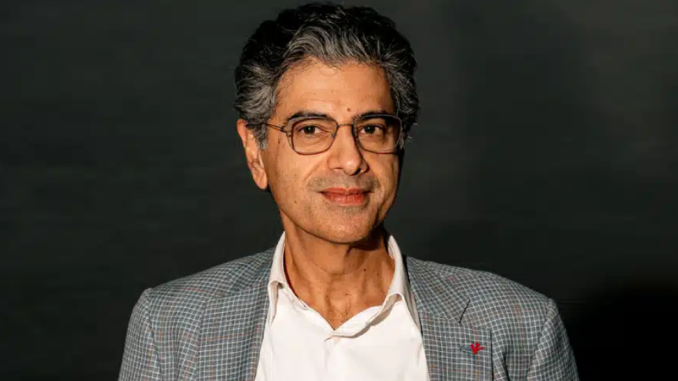
Alok Sama is a globally recognised financial strategist and keynote speaker, renowned for shaping some of the most transformative deals in modern business.
From his leadership roles at Morgan Stanley and SoftBank Group International to landmark transactions such as the Sprint–T-Mobile merger and ARM acquisition, he offers unparalleled insight into global markets.
In this exclusive interview with The Champions Speakers Agency, Alok reflects on his career, the evolving landscape of finance, and the lessons that continue to shape his outlook on innovation and resilience.
Q: With the dominance of Big Tech, do you believe company size is hindering innovation and productivity, or can scale actually drive progress?
Alok Sama: “For yeah, I think the issue of size comes up in the context of the US Magnificent Seven, certainly the Google, Microsoft and others. And I, for one, I’m not convinced that size is the enemy of innovation.
“If you go back and look at the history of technology innovation, back in the 60s and 70s, the centre of innovation was less Silicon Valley, it was Bell Labs, right? And Bell Labs was a part of AT&T, which is the ultimate monopolist in terms of monopoly on the telecommunications business in the United States.
“And even at Google, for example, the innovation at Google unrelated to its core business – DeepMind is a great example. You saw the Nobel Prize go to a couple of people from Google as a result of the work they’ve done on protein folding. You know, that’s been quite amazing, transformative.
“I mean, again, out of Google – autonomous cars, that technology again nothing to do with Google’s core business, but that’s something they invested in, suffered huge losses over a period of time, and now it’s very real. I mean, I rode in my first Waymo a few weeks ago and there’s no looking back. You just know that’s what the future is.
“And some of these companies, founder-controlled companies, they’ve been just so enormously successful, cash-generated, they have the ability to invest in unrelated businesses that can be quite profound in terms of the impact they make on technology, on humanity generally speaking.
“Having said that, there is scope for abuse. I mean, Amazon for example, in terms of the power that it has and how it exercises it in the context of its marketplace. Those are things that the regulators need to watch out for.
“And I think, I for one, I’m a big fan of behavioural remedies as opposed to structural remedies. In other words, dictate how people behave in the conduct of their business as opposed to outright break-ups. Just not convinced that would accomplish anything. In the case of Google, for example, which is a case that’s going to be litigated over the next several years.”
Q: When assessing an investment, what fundamental factors do you prioritise before buying a stake or acquiring a business outright?
Alok Sama: “Technology investing on some level is a numbers game. You know you have to take a portfolio approach. So if you make 10 investments, for example, you know that a couple are going to be outright dogs – I mean complete write-offs. Some are going to be middling performers, and you invest in the hope that at least one is going to be a home run.
“And if you take that approach, then you have to start off, when you look at an investment, you have to start off looking at the addressable market and whether this business can be huge, and make up for the dogs that you’re inevitably going to have in your portfolio. So, you know, not just a 10-bagger but potentially a 100-bagger.
“And so for that, you look for businesses that have the potential to become huge businesses, to become unicorns, decacorns and beyond – so that’s one. And then you look for product-market fit. So it’s one thing for the market to be large, but you equally have to have a product that kind of fits with the needs of that marketplace. So product-market fit is crucial.
“And then third, but by no means least, is the entrepreneur. You need to look for entrepreneurial resilience. Has this individual, he or she, dealt with failure? It’s kind of a cliché, but it’s a stepping stone to success almost.
“So you look for resilience, you look for flexibility – whether this individual will listen to investors, will listen, whether the founder will be flexible. Lots of twists and turns inevitable along the way, will they be flexible and listen to the board, take guidance?
“So those are some of the characteristics that you look for in a founder. And so, you know, those three factors: large addressable markets, product-market fit and, very importantly, very crucially, the founder. Those are the things I would look for.”
Q: Looking ahead, how do you see the future of the technology sector unfolding, and to what extent will artificial intelligence reshape the landscape?
Alok Sama: “Yeah, I think the answer to that question is in the second half of the question, which is I do think that AI will be a game changer – indeed, it already is a game changer. And that probably is the future of the tech industry, to the degree one can predict the tech industry at all.
“If you look at AI, the action right now is at the enterprise level. And by the way, the AI phenomenon is not just a game changer for the technology industry, it’s a game changer for businesses generally. How well a business integrates AI into its entire value chain will become a key determinant of profitability and competitive advantage.
“The simplest way to think about AI at the enterprise level is as a productivity tool. The more robotic functions – call centre workers, coding, parallel research, analytics of all kinds – those are the most easily disrupted. But over time you will see new businesses evolve.
“The jury is still out in terms of how AI works at the individual level. So far, it’s been for amusement – you know, people coming up with AI-generated photographs of themselves, I’ve played with those sorts of things – but we haven’t seen the same types of business models that we did with Web 2.0, Uber for example. But over time that will happen, and it will be very exciting.
“So the excitement right now, to come back to the central question in terms of technology investing – arguably an overhype – is in and around AI. It’s around not just the large language models like OpenAI, but around applications. And it will increasingly become clear what those applications are, from an investment standpoint.”
This exclusive interview with Alok Sama was conducted by Mark Matthews of The Motivational Speakers Agency.