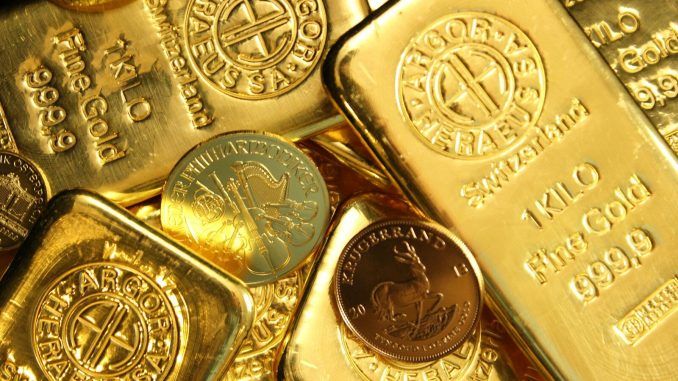
Gold prices remained resilient on Thursday as investors turned their attention towards Federal Reserve Chair Kevin Warsh’s highly anticipated address at the Jackson Hole Economic Policy Symposium.
The precious metal has enjoyed a particularly strong August, supported by concerns over US fiscal policy, persistent inflation and renewed demand from investors looking for protection against economic and geopolitical uncertainty.
While recent US inflation figures have complicated expectations for the next move in interest rates, gold has continued to trade at historically elevated levels, with markets now looking to Warsh for clues about the direction of Federal Reserve policy.
Konstantinos Chrysikos, Head of Customer Relationship Management at Kudotrade, commented:
“Gold prices were almost unchanged today after retreating from a three-month high yesterday. The asset could remain exposed to some price corrections as traders continue to react to yesterday’s inflation data.
“At the same time, attention is shifting toward the Federal Reserve Chair Kevin Warsh’s address at Jackson Hole on Friday. Any indication of a more hawkish policy stance could lift US yields and pressure gold, while a dovish tone could support a rebound in prices.
“However, ongoing geopolitical and trade uncertainties continue to support safe-haven demand. Strong central bank purchases and renewed inflows into gold-backed ETFs could also help sustain gold prices over the medium term.”
Inflation Keeps Interest Rate Debate Alive
The Federal Reserve faces a difficult balancing act as policymakers attempt to bring inflation sustainably back towards the central bank’s 2% target without placing unnecessary pressure on the wider US economy.
Latest inflation figures have reinforced concerns that price pressures remain persistent, potentially limiting the Federal Reserve’s room to adopt a more accommodative monetary policy.
That matters considerably for gold.
Unlike bonds and savings products, bullion does not pay interest. Higher interest rates and rising bond yields can therefore make gold relatively less attractive to investors, while expectations of lower rates can increase its appeal.
Consequently, any indication from Warsh that US monetary policy needs to remain restrictive – or become more restrictive – could provide support for Treasury yields and the dollar while creating short-term pressure on gold.
A more cautious or dovish message could have the opposite effect.
Jackson Hole Could Set The Tone For September
Warsh’s speech will be particularly closely scrutinised because it comes ahead of the Federal Reserve’s September policy meeting.
Jackson Hole has traditionally provided Federal Reserve chairs with an opportunity to discuss the broader economic outlook and, on occasion, signal significant changes in monetary policy.
Warsh’s appearance carries additional importance this year as investors seek greater clarity over how the Fed intends to respond to stubborn inflation, changing economic conditions and elevated long-term borrowing costs.
The Federal Open Market Committee kept interest rates at 3.50% to 3.75% at its July meeting, although policymakers have been divided over whether further tightening may ultimately be necessary.
Markets therefore face considerable uncertainty over the Fed’s next move.
US Fiscal Concerns Add Another Layer Of Support For Gold
Interest rates are not the only factor supporting bullion.
Gold has also benefited from renewed concerns surrounding US government debt and fiscal sustainability.
Recent intervention by the US Treasury in longer-dated government bonds has helped revive what traders sometimes describe as the “debasement trade” – where investors increase their exposure to assets such as gold because of concerns that government borrowing, inflation or currency weakness could erode the value of conventional financial assets.
Gold has consequently recorded a particularly strong performance during August, despite the prospect that US interest rates could remain elevated.
That resilience suggests investors are looking beyond immediate monetary policy and considering wider concerns about government debt, inflation and the long-term purchasing power of the dollar.
Safe-Haven Demand Remains An Important Factor
Geopolitical uncertainty is providing another source of support.
Gold has historically attracted investors during periods of heightened political, economic and financial risk, and continuing uncertainty surrounding international trade and geopolitical tensions has helped underpin demand.
Central banks have also become increasingly important participants in the gold market, with sustained official-sector buying helping provide longer-term support for bullion.
Meanwhile, renewed investment into gold-backed exchange-traded funds indicates that institutional and private investor interest remains strong.
Together, these factors could help cushion gold from some of the pressure that would ordinarily be expected from higher interest rates and bond yields.
What Happens Next For Gold?
For investors, Friday’s Jackson Hole speech could provide the next significant catalyst.
A distinctly hawkish message from Warsh – particularly one indicating that further rate increases remain a realistic possibility – could strengthen the dollar and push Treasury yields higher, potentially triggering another pullback in gold.
Conversely, a more balanced assessment of inflation and the US economy could allow bullion to resume its recent upward momentum.
The bigger picture, however, remains unusually complex.
Gold is currently being influenced by competing forces: persistent inflation and the possibility of higher interest rates on one side, and fiscal concerns, central bank buying, geopolitical uncertainty and safe-haven demand on the other.
That combination means Warsh’s words in Wyoming are likely to be watched well beyond the gold market.
For bullion investors, the key question will be whether the Federal Reserve Chair reinforces expectations of prolonged restrictive monetary policy – or gives markets reason to believe that the next phase of US monetary policy could eventually become more supportive for gold.