
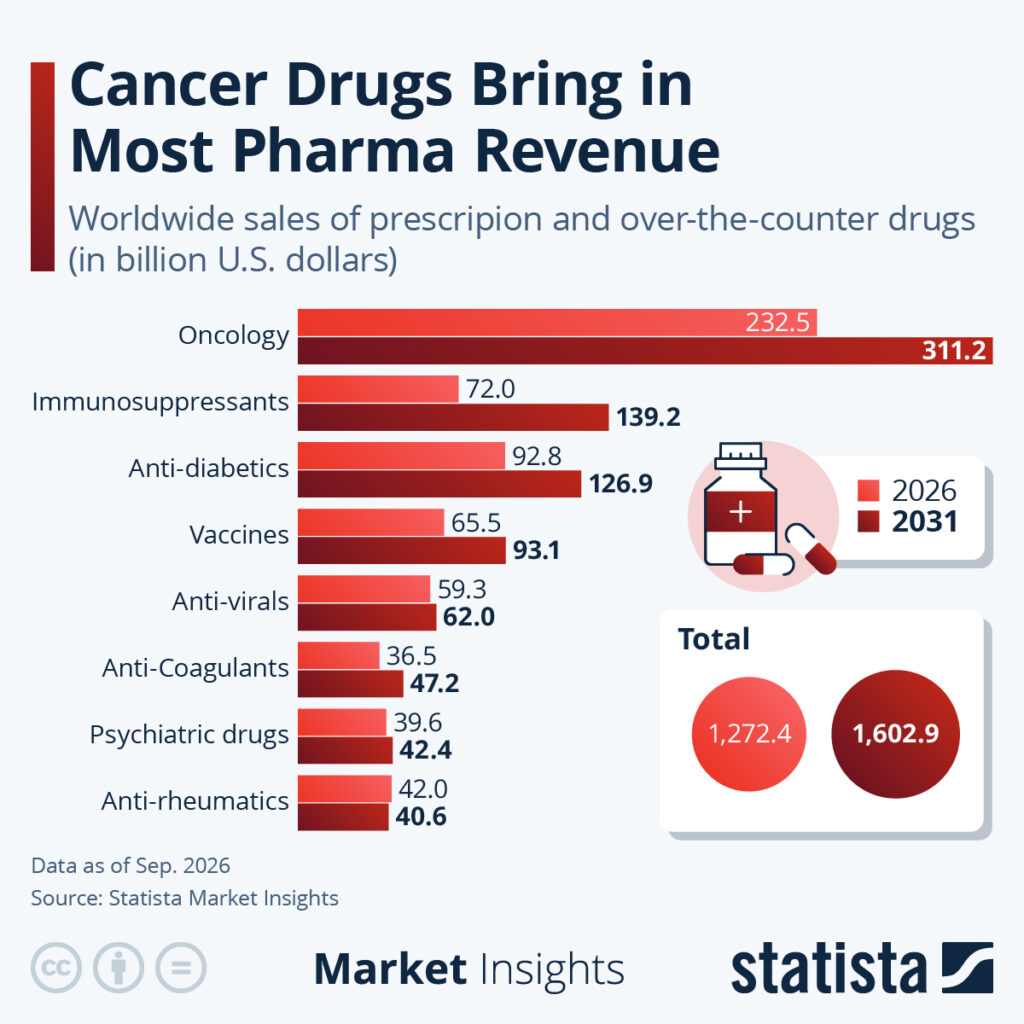
Cancer medicines are forecast to generate approximately £235 billion in annual global sales by 2031, placing oncology firmly on the radar of investors assessing long-term pharmaceutical demand.
Statista Market Insights estimates that revenues will rise from approximately £175 billion in 2026, an increase of around £59 billion over five years. Calculated from its underlying dollar figures, that represents roughly 34% total growth, or approximately 6% a year.
The scale is significant. However, translating an expanding treatment market into investment returns requires a closer examination of individual businesses, their products and the expectations already reflected in their valuations.
A Growing Market Does Not Guarantee Growing Profits
Statista expects oncology to account for close to one-fifth of worldwide pharmaceutical revenues by 2031.
That establishes the size of the commercial opportunity, but an industry sales forecast cannot show how much of that opportunity any particular company will capture.
Investors assessing a pharmaceutical business need to connect market demand with its own revenue prospects. Relevant questions include whether it already sells established treatments, how dependent it is on a small number of products and what evidence supports the potential of medicines still in development.
Revenue also needs to be considered alongside expenditure. Research, manufacturing, commercial operations and the cost of acquiring or licensing products all influence how much sales growth ultimately reaches shareholders.
Examine the Evidence Behind the Pipeline
For a developer without substantial commercial revenues, the investment case may rest heavily on future clinical results.
A useful assessment should distinguish between the size of the disease market and the realistic opportunity for a particular treatment. The relevant patient population may be narrower than a headline estimate suggests, while competing medicines may already address some of that need.
Questions about clinical benefit, safety, development timelines and funding requirements therefore deserve as much attention as potential peak sales.
Investors should also examine the assumptions behind management forecasts. A projection based on broad patient eligibility, rapid adoption and sustained pricing warrants scrutiny of all three assumptions.
 Access and Affordability Shape Commercial Potential
Successful development is only one component of a medicine’s commercial prospects.
Healthcare purchasers must decide how a treatment fits into their budgets and existing care pathways. In England, NICE’s appraisal framework examines clinical effectiveness and value for money when developing recommendations for NHS use.
For investors, this makes evidence relevant to healthcare purchasing an important part of commercial due diligence. A product’s prospects depend on the benefits it can demonstrate against available alternatives and the terms on which healthcare systems will fund its use.
The distinction is particularly relevant when evaluating treatments whose projected revenues assume widespread adoption.
Consider Valuation Alongside the Growth Story
An attractive market can still produce a disappointing investment if the purchase price assumes more success than a company delivers.
Investors can test that risk by considering several scenarios: development taking longer than expected, adoption progressing more slowly, greater competition or higher spending before a product becomes commercially established.
For businesses with limited revenues, the cash position and likely financing needs also matter. Future fundraising can change the proportion of the business held by existing shareholders.
For UK investors holding overseas assets, currency movements add another variable to sterling returns.
Statista’s forecast provides a useful starting point for identifying the scale of oncology spending. The next step is company-specific analysis: determining who can convert demand into durable earnings, how much uncertainty remains and whether the valuation adequately reflects it.
Currency note: Sterling figures use £1 = $1.3253, the reported Bank of England rate for 15 October 2026. Both years are converted at the same rate. Growth calculations use Statista’s estimates of $232.5 billion in 2026 and $311 billion in 2031.
Sources: Statista: Cancer Drugs Bring in the Most Pharma Revenue — October 2026 update.