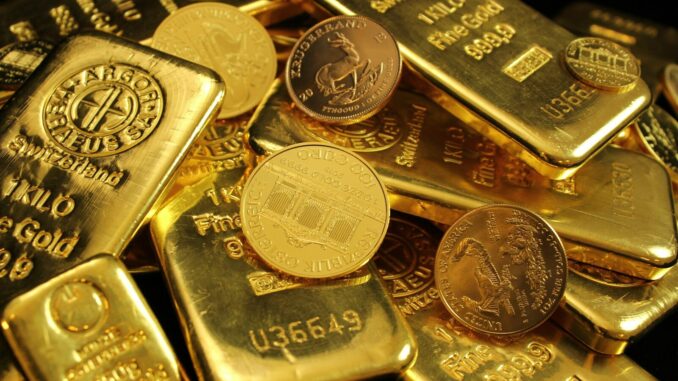
Gold prices are attempting to stabilise after falling to their lowest level in approximately 14 months, as a stronger US dollar, elevated Treasury yields and expectations of further Federal Reserve interest rate increases continue to put pressure on the precious metal.
Trading around $3,860 per ounce, gold has staged a modest recovery from its recent lows, but analysts warn that the rebound remains fragile as investors assess the outlook for US inflation and monetary policy.
The metal, traditionally regarded as a safe-haven investment during periods of economic uncertainty, has struggled to attract sustained buying interest as higher interest rates increase the appeal of income-generating assets.
Attention is now turning to the minutes of the Federal Reserve’s October policy meeting, with investors looking for indications of how aggressively US policymakers may need to respond to persistent inflation.
Antonio Di Giacomo, Senior Market Analyst at XS.com, believes that while gold may be approaching an important technical area, the strength of the dollar and movements in US Treasury yields will be critical in determining whether prices can establish a lasting recovery.
Gold Attempts to Recover as Monetary Policy Pressure Persists
Gold’s recent decline reflects changing expectations for US interest rates, with investors increasingly anticipating that the Federal Reserve will maintain a restrictive monetary policy stance.
Higher interest rates can reduce the attractiveness of precious metals because investors can potentially earn returns from government bonds and other interest-bearing instruments.
At the same time, a stronger dollar can make gold more expensive for international buyers, adding further pressure to demand.
In his latest market analysis, Di Giacomo explains:
Gold is trying to regain stability after falling to its lowest level in about 14 months, amid dollar strength and expectations of further Federal Reserve interest rate hikes. Trading around $3,860 per ounce, the metal is posting a modest rebound, although it still faces conditions that make a sustained recovery difficult.
Persistent U.S. inflation remains one of the main obstacles for the market. With price pressures potentially lasting longer, investors have shifted their expectations toward a more restrictive monetary policy. This scenario reduces gold’s relative appeal and keeps market participants cautious.
The relationship between inflation, interest rates and gold is particularly important in the current market environment.
Although gold is often considered a potential hedge against inflation, its performance can be negatively affected when central banks respond to rising prices by increasing interest rates.
Consequently, persistent inflation does not automatically translate into stronger gold prices, especially when investors expect monetary policy to become more restrictive.
Federal Reserve Comments Reinforce Rate Hike Expectations
Recent comments from Federal Reserve officials have added to market uncertainty over the timing and scale of future interest rate decisions.
Policymakers face the challenge of controlling inflation without placing excessive pressure on economic activity, employment and financial markets.
The pace of monetary tightening is particularly important for gold because changes in interest rate expectations can influence both the dollar and government bond yields.
Di Giacomo said:
Comments from Beth Hammack, president of the Federal Reserve Bank of Cleveland, have reinforced this perception. She expressed a preference for gradual, measured interest rate increases, while acknowledging that larger adjustments could be necessary if inflation accelerates. Her remarks leave the debate open over the scale of upcoming monetary policy decisions.
For gold, higher interest rates increase the opportunity cost of holding the metal. Since gold pays neither interest nor dividends, it becomes less attractive compared with instruments that offer regular returns. However, the extent of this pressure also depends on inflation expectations and movements in real yields.
Real yields, which account for inflation expectations, are particularly relevant to precious metals.
When real yields rise, investors may find interest-bearing assets more attractive relative to gold. Conversely, falling real yields can improve the metal’s appeal, even when nominal interest rates remain relatively high.
This means that the direction of inflation expectations can be just as important as the Federal Reserve’s headline interest rate decisions.
Strong Dollar and Treasury Yields Create Additional Challenges
The US dollar has remained firm as markets anticipate further monetary tightening, creating another obstacle for gold prices.
Because gold is generally priced internationally in dollars, movements in the US currency can influence purchasing costs for buyers in other countries.
A stronger dollar can reduce affordability for overseas investors, potentially limiting demand.
At the same time, elevated US Treasury yields increase competition for investment capital, particularly among investors seeking defensive assets.
Di Giacomo explained:
Dollar strength adds another challenge. An appreciation of the U.S. currency makes gold more expensive for buyers using other currencies, potentially weakening international demand. At the same time, rising Treasury yields increase competition for capital and limit buying momentum in the metal.
The interaction between currency markets and bond yields is likely to remain a significant influence on gold’s near-term direction.
If Treasury yields continue rising, the opportunity cost of holding gold may increase further.
However, a decline in yields or a weakening dollar could create more favourable conditions for a recovery, particularly if investors begin to anticipate a less restrictive Federal Reserve policy stance.
Technology Stock Weakness Adds to Selling Pressure
Gold’s recent performance also highlights how financial market volatility can affect assets traditionally regarded as defensive investments.
Although gold often attracts demand during periods of uncertainty, it is not immune to selling pressure when investors need to raise cash.
Sharp declines in equity markets can sometimes prompt investors to liquidate profitable or relatively liquid positions elsewhere in their portfolios.
This can happen when market participants face margin calls, seek to reduce overall exposure or need funds to offset losses.
Di Giacomo noted:
Weakness in the technology sector has also contributed to selling. During periods of stock market losses, some investors liquidate gold positions to raise cash, meet margin calls, or offset declines in other assets. This dynamic helps explain why the metal can fall even when financial uncertainty increases.
This behaviour can produce periods in which gold and equities decline simultaneously, despite the precious metal’s traditional reputation as a safe haven.
Such movements demonstrate that short-term liquidity requirements and investor positioning can sometimes outweigh longer-term investment considerations.
For gold investors, this means that wider financial market conditions remain important, particularly during periods of significant volatility in technology shares and other risk-sensitive assets.
Federal Reserve Minutes Could Provide the Next Market Catalyst
The next major event for gold traders is the publication of the Federal Reserve’s October meeting minutes.
The document is expected to offer further insight into policymakers’ discussions about inflation, employment and the appropriate path for interest rates.
Investors will be particularly interested in whether officials broadly support additional tightening or whether there are signs of disagreement about the need for further increases.
Di Giacomo said:
Immediate attention is focused on the minutes of the Federal Reserve’s October meeting, scheduled for release on Wednesday, November 18. The document will provide greater insight into discussions about inflation, employment, and monetary policy. Markets will look for signals about the level of support for potential rate increases and the conditions that could justify them.
A more hawkish interpretation of the minutes could strengthen expectations for further rate increases, potentially supporting the dollar and Treasury yields.
That scenario could create renewed pressure on gold prices.
Conversely, indications that policymakers are becoming more cautious about additional tightening could encourage investors to reassess the outlook for interest rates, potentially providing some relief for the metal.
The market reaction will depend not only on the content of the minutes but also on how closely they align with expectations already reflected in asset prices.
Gold Price Outlook: $3,900 and $3,800 Become Key Levels
Technical analysis is also playing an important role as traders assess whether gold is approaching a potential turning point.
Following the recent decline, the $3,900 level has emerged as an initial area of interest for investors monitoring the possibility of a recovery.
A sustained move above this level could suggest that buying interest is returning, although further confirmation would be needed before concluding that the broader downward trend has reversed.
Meanwhile, the $3,800 area represents another important psychological reference point if selling pressure intensifies.
Di Giacomo explained:
From a technical perspective, the $3,900 area represents an initial psychological reference point for assessing the potential for recovery. A sustained move above that level could help ease selling pressure, while renewed declines toward recent lows would leave prices vulnerable. The $3,800 area is another relevant round-number reference, although these levels should be viewed as areas to monitor rather than guarantees of a price reaction.
These price levels may help traders assess market sentiment, but technical support and resistance areas do not guarantee future price movements.
Unexpected economic data, changes in Federal Reserve expectations or developments in global financial markets could quickly alter the outlook.
Can Gold Establish a Sustainable Recovery?
Despite the modest rebound, gold remains vulnerable to further volatility as investors await clearer signals from the Federal Reserve.
The central question is whether expectations for additional monetary tightening will continue to dominate market sentiment or whether economic developments will encourage investors to reconsider the outlook for US interest rates.
Di Giacomo said:
In the short term, gold’s performance will depend primarily on how the dollar and U.S. yields respond to economic data. Easing expectations for monetary tightening could support a rebound, while fresh signs of persistent inflation could prolong the challenges. For now, price stabilization still needs confirmation through a more consistent recovery.
The outlook therefore remains closely linked to developments in US inflation, monetary policy and financial market sentiment.
A sustained weakening of the dollar or decline in real Treasury yields could provide a more supportive environment for gold.
However, if inflation remains persistent and the Federal Reserve signals further tightening, the metal could struggle to build on its recent recovery.
Outlook Remains Cautious Ahead of Fed Signals
Gold’s attempt to stabilise near its recent lows comes at a time when monetary policy expectations are exerting considerable influence over precious metals markets.
While the metal continues to offer diversification potential for some investment portfolios, its short-term performance remains sensitive to interest rates, currency movements and wider financial market conditions.
Di Giacomo concluded:
In conclusion, gold is in a period of vulnerability, with interest rate expectations outweighing its safe-haven appeal. The modest rebound around $3,860 provides some relief, but does not, on its own, confirm a change in trend. The Fed minutes and the dollar’s performance will be crucial in determining whether the metal establishes a base for recovery or faces renewed selling pressure.
For investors, the coming sessions could prove important in establishing whether gold can regain momentum above $3,900 or whether continued dollar strength and elevated yields will leave the metal exposed to further declines.
Until clearer evidence of a sustained recovery emerges, the balance of risks remains closely tied to the Federal Reserve’s monetary policy outlook and the reaction of US bond and currency markets.
Market analysis provided by Antonio Di Giacomo, Senior Market Analyst at XS.com.
Source
XS.com – https://www.xs.com/
Disclaimer: This article is for general information purposes only and does not constitute financial or investment advice. Gold and other financial assets can rise or fall in value, and investors should seek independent professional advice before making investment decisions.